
5 min read · September 13, 2026
When Google and AI Become Part of the Anxiety Cycle
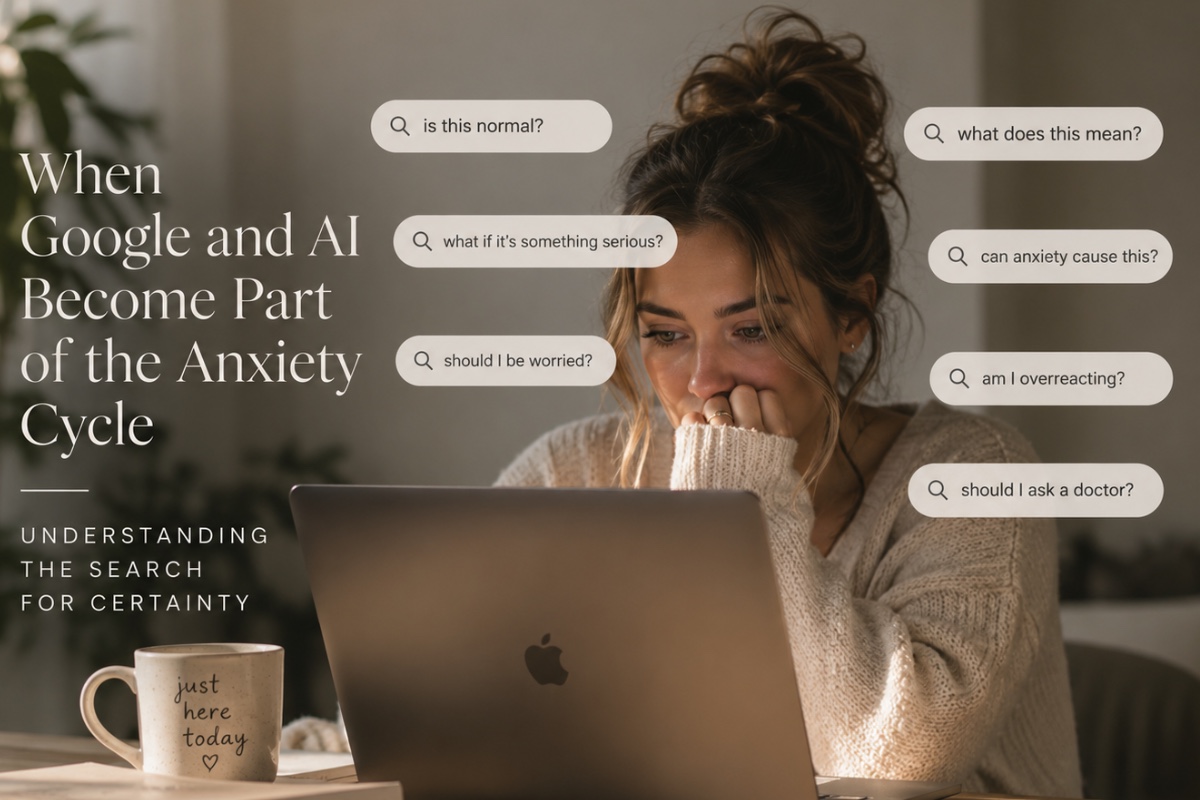
If you struggle with anxiety, you may know the feeling of needing to know.
You notice something in your body and wonder if it's normal. You send a text and start worrying that you said the wrong thing. You make a decision and immediately wonder whether you made a mistake. Or maybe something happened at work and your brain starts running through every possible outcome.
So you search, Google it, ask AI, and maybe you look through Reddit. You read other people's experiences. You ask someone you trust. And for a moment, you feel better. Then another question pops up. But what if?! So you search again.
This is something I see often with anxiety: the search for information can slowly become a search for certainty.
There is nothing wrong with using Google or AI to find information. In fact, both can be incredibly useful. The question is what you're hoping the search will do for you.
Are you looking for information because you genuinely want to learn something? Or are you hoping the answer will finally make you feel completely certain and take away the anxiety? Those two things can look very similar, but they can lead to very different patterns.
Research has found a relationship between health anxiety and repeated online health-information seeking. When searching becomes excessive or distressing studies suggest that online searching can become a form of reassurance-seeking or a safety behaviour, particularly for people who have difficulty tolerating uncertainty.
The tricky part is that reassurance often works—at least temporarily.
You find something that makes you feel better, and your anxiety drops. Your brain learns: “Searching helped. I should do that again next time.” So the next time you're anxious, you search a little sooner. Maybe you search a little longer. You ask a few more questions. You look for another source just to make sure.
And eventually, the thing you're doing to reduce anxiety can actually become part of the anxiety cycle.
What about Obsessive Compulsive Disorder (OCD)?
There can be some overlap here, but the behaviour doesn't always mean OCD.
For someone experiencing more general anxiety, searching may be an attempt to understand a worry, prepare for something, or feel more certain about what might happen. For someone with OCD, searching may function more specifically as a compulsion—a behaviour performed in response to an intrusive thought or fear in an attempt to reduce distress or prevent something bad from happening.
The behaviour can look very similar from the outside, but the underlying pattern can be different.
The bigger question
The issue isn't that using Google or AI is inherently bad. Online information can be incredibly helpful, and AI can be a useful tool for learning and exploring questions. The concern is when searching becomes something we increasingly rely on to manage anxiety or obtain reassurance. When we're already feeling uncertain, having immediate access to endless information can make it very easy to keep searching for the answer that will finally make us feel certain.
And sometimes, there simply isn't an answer that can provide that level of certainty. So rather than asking whether searching online is “good” or “bad,” it can be more helpful to consider what role it is playing in your anxiety.
If you find yourself repeatedly searching, checking, or seeking reassurance because of anxiety, it may be worth bringing this pattern into therapy. A mental health professional can help you understand what is driving the behaviour and determine what kind of support may be appropriate.
It's also important to remember that information from Google, AI, social media, or online forums should not replace professional judgement. AI tools cannot assess you, diagnose you, or provide the same individualized care as a qualified healthcare professional. If you have concerns about your physical or mental health, seeking appropriate professional advice is important.
This article is for general educational and informational purposes only and is not a substitute for professional mental health advice, assessment, diagnosis, or treatment.
References:
Muse, K., McManus, F., Leung, C., Meghreblian, B., & Williams, J. M. G. (2012). Cyberchondriasis: Fact or fiction? A preliminary examination of the relationship between health anxiety and searching for health information on the Internet. Journal of Anxiety Disorders, 26(1), 189–196. https://doi.org/10.1016/j.janxdis.2011.11.005
If any part of this resonated and you're curious about therapy, you don't have to navigate it alone.